
Magician Jeanette Andrews Unpacks the Art of Deception
Andrews will perform all sorts of wonders at the HCL Fall Benefit on Tuesday, Nov. 10 (Tickets on sale now). This is the first installment of a two-part interview.
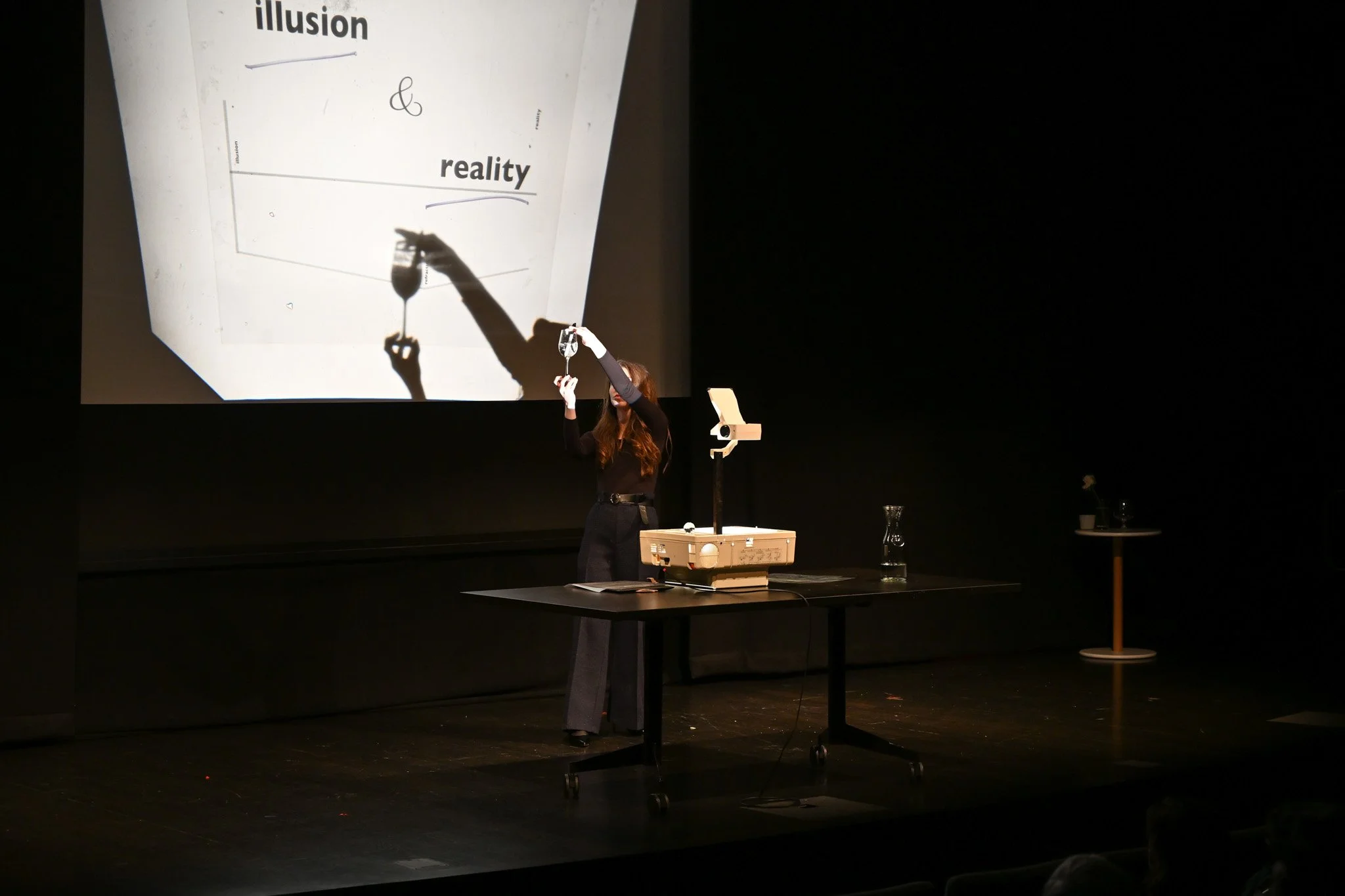
Photo credit: SFMOMA, Desiree Harris
High Concept Labs (HCL): In your research and within your practice, you explore how magic relies on something called “disinformation design,” (a term pulled from Jamy Ian Swiss in Visualizing Explanations), where subtle framing primes an audience to believe in an impossibility. I would love for you to tell me more about how that works.
Jeanette Andrews: One of the things that I find really interesting about magic is what it shows us about the robustness of our deeply held assumptions about the world. We as human beings, from the time we are infants, have a really robust understanding of the way that the objects around us work.
If I hold a pencil, you have an intuition about which way it's going to fall if I loosen my grip. You know exactly, probably, the rate at which it's going to fall. You know the trajectory. You know everything that's going to happen with that pencil, just by seeing the exact position of how I'm holding it as a starting place. We understand these sorts of things about the world so deeply. We understand how objects behave, how they interact with each other, and what our expectations of them are.
I think we feel like we have robust control over our own attention, but magic shines a spotlight on how your attention can be manipulated. Point blank, you know that's what's going on. You know you're being deceived, and by the fact that you didn't walk away or close your eyes, you're partaking in that willing manipulation of your attention.
Magic affords us questioning [our attention], as opposed to [how] I probably didn't question it when I was scrolling Instagram today. Do I question the algorithm, or why I spent five more minutes on something than I intended to? Not as often as I should— of course not.
HCL: When we think of deception it has negative connotations. But you're talking about a consensual deception, where it's something positive, something that an audience is choosing to take part in.
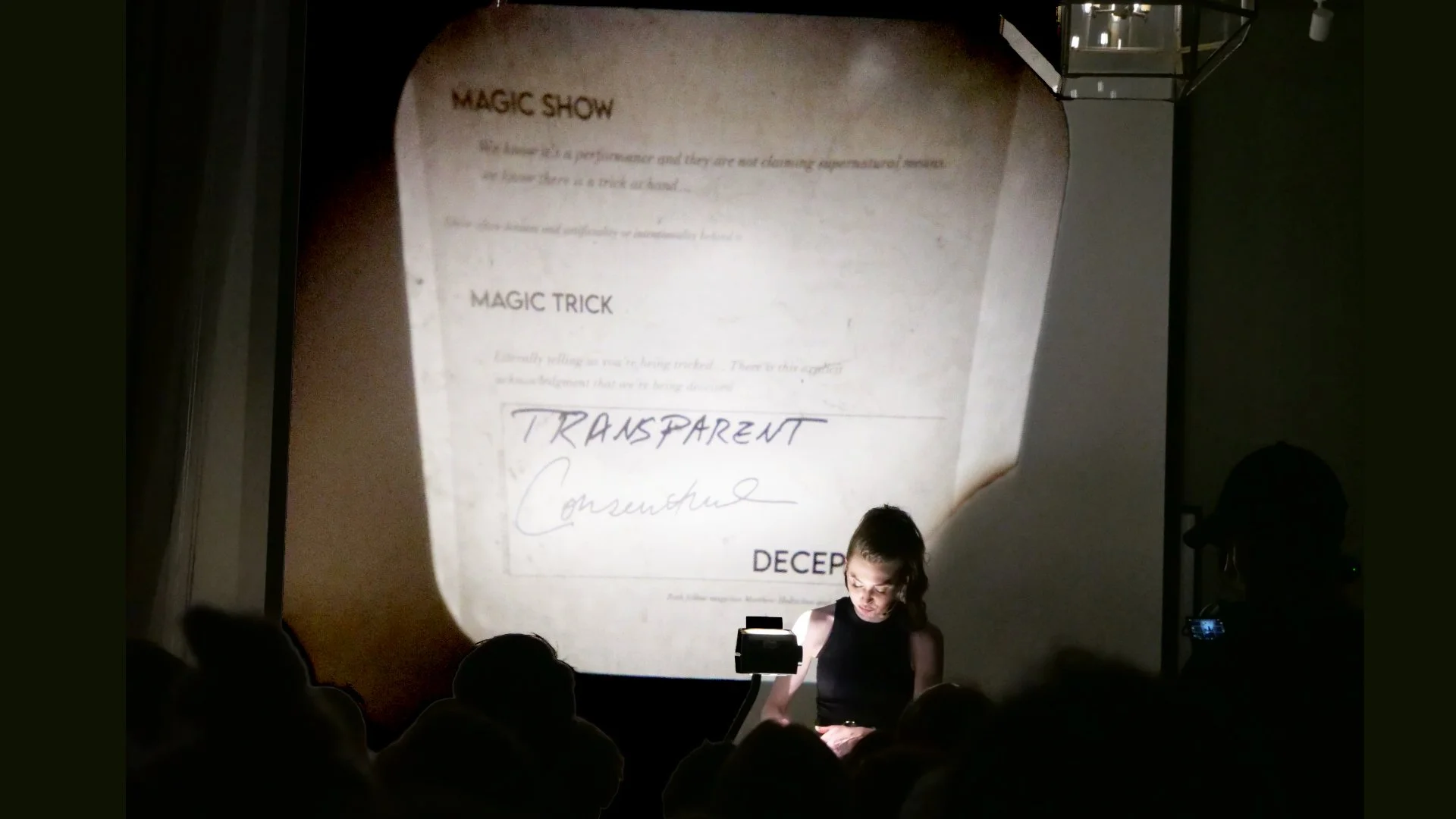
Photo credit: Ari Isenberg
Jeanette Andrews: Typically, for a deception to work as a deception, you can't know in advance. For example, I got a call from somebody pretending to be my bank. For a while I thought I’d have to shut my card down. I was successfully deceived because I thought it was real— as opposed to magic, where you know you're being deceived the whole time.
It’s still functionally doing the same thing, but with magic people are willingly giving into this and having fun with it. Most people, because of the foreknowledge of deception, enjoy the experience. That actually ends up creating a really interesting power dynamic between the audience and the magician. This is something I will also talk about in my HCL performance lecture— this idea of reciprocal trust within the magic performance, how that's working in terms of deception and vulnerability, and how that's all creating this really delicate balance. So I think magic is really unusual in this sort of way.
HCL: What is it that makes us interested or even excited by being willing participants in an act of deception?
Jeanette Andrews: There's a philosopher named C. Thi Nguyen. His conjecture for why people like being on roller coasters, and I suspect it's very close to why people like magic, is that you have this very narrowly bracketed loss of bodily control on a roller coaster. It is very clear where it starts, where it ends, and who's in control. Outside of the context of a roller coaster, if you were on a road trip and the road got really crazy— you’d be having an absolute heart attack!
People like having really narrow parameters on loss of control. If you were to experience [magic] outside of that really narrow, bracketed experience, it would be absolutely terrifying. I do object transformations in my work, or things that change color. But if I'm sitting here, and the beige linen curtain I'm looking at turns purple— I'm going to the ER, I might be having a stroke. But if you see that in a magic trick, you're like: whoa, fun!
We like having visual or perceptual loss of control, and we also like having this sort of epistemic loss of control. Normally, if somebody tells us we're wrong about a belief that we have, that is either combative or feels really personal. Within the context of a magic show, it’s not threatening.
HCL: So perhaps it’s not so much that we enjoy being deceived, but that in a world where we are able, or feel we are able to know everything, it's nice to not know. So often we don't get to experience wonder in the same way that we used to. I think it's beautiful that your practice reminds the audience of that wonder that we forget about sometimes. Really, that's what the best artists do.
Article by Max Collins
